How we price a build
Ask several shops to build the same software and the quotes rarely agree. Three things drive most of the difference, and two of them are measurable.
Ask several shops to build the same software and the quotes rarely agree. Three things drive most of the difference, and two of them are measurable.
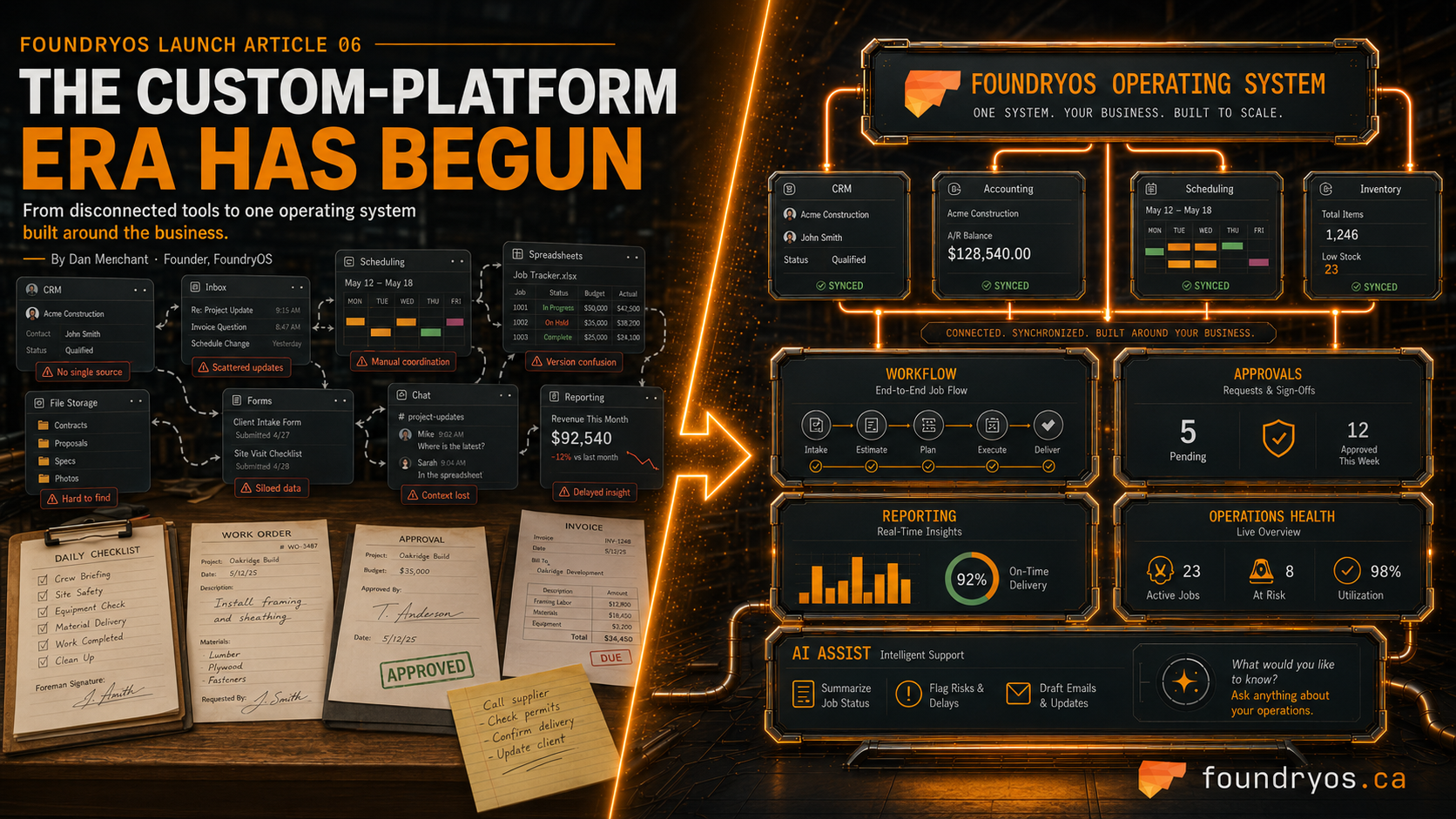
For thirty years, businesses have been digitizing themselves. Paperwork moved onto screens. Customer records, accounting, scheduling, projects, and communications moved into software. Today, even relatively small companies can have a dozen systems involved in running the business.
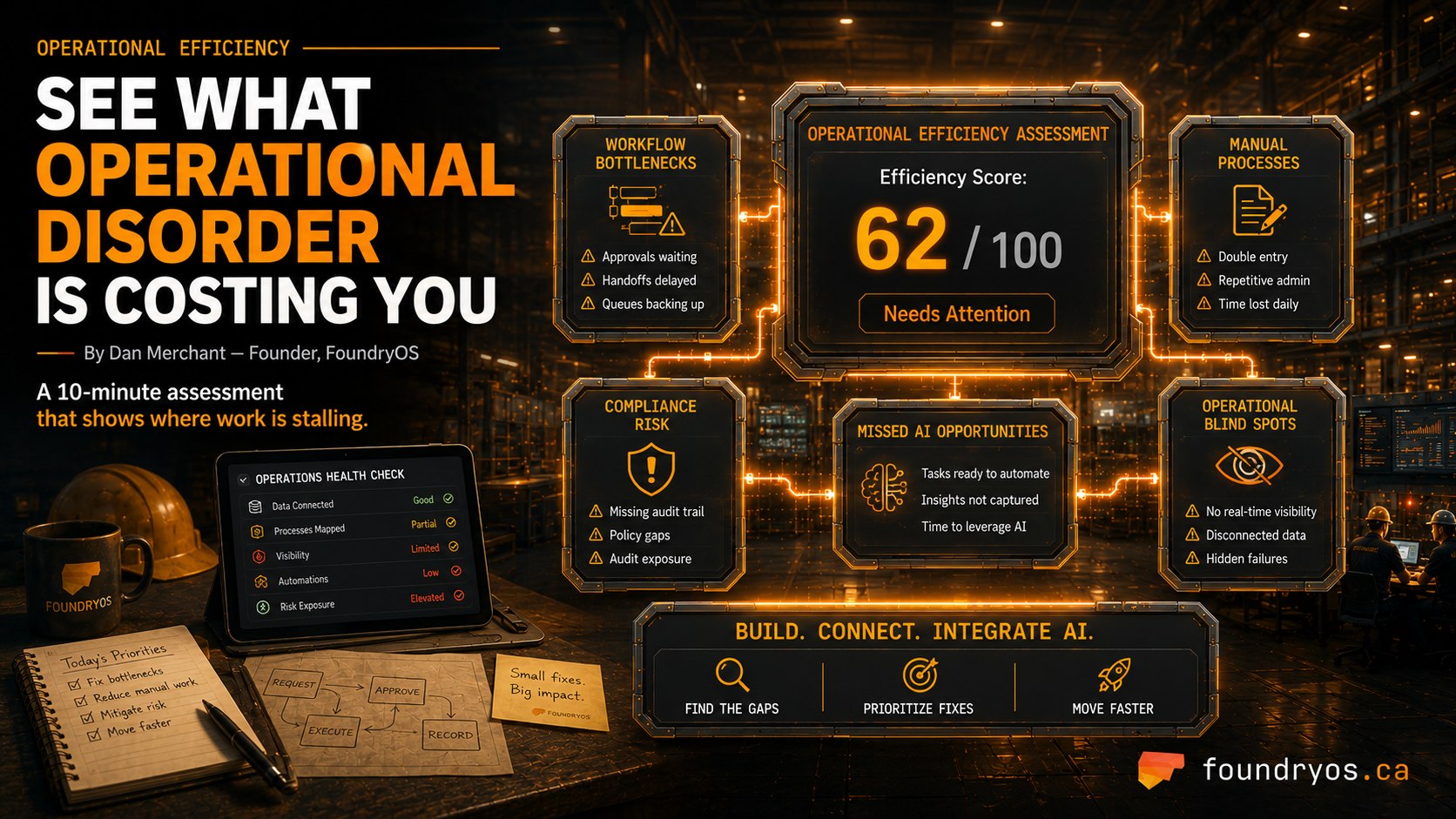
You score it across five dimensions: where work stalls, which tasks are still manual, where compliance gaps hide, where you have no real-time visibility, and where AI could close a gap today. Most businesses have never measured any of them.
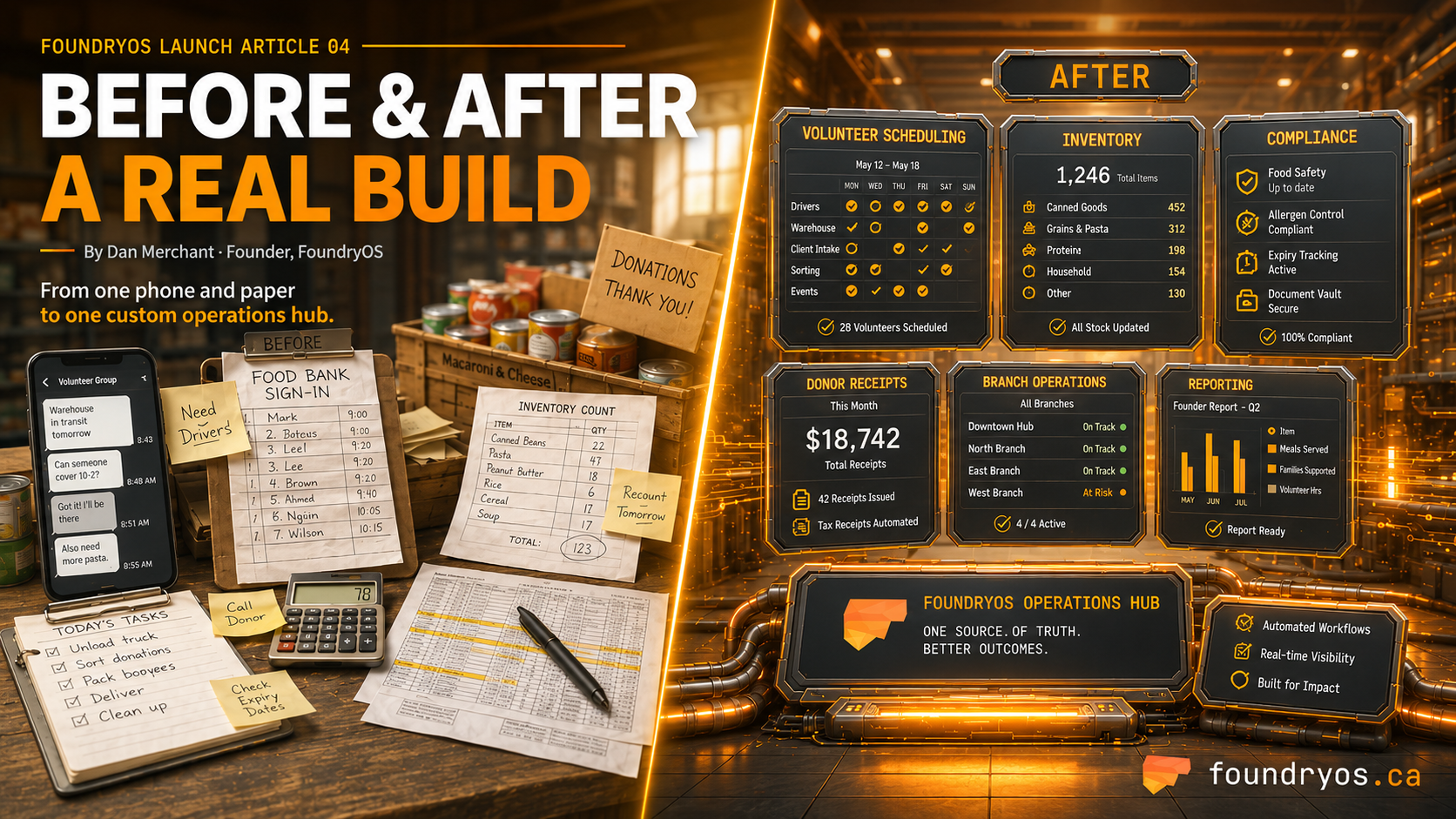
A community food bank in Atlantic Canada was coordinating its entire operation from a single person's phone. One director held the whole thing together with text messages, a few spreadsheets, and a stack of paper. Food inventory was counted by hand. Funder reports were assembled at month-end from scattered logs. Volunteer coordination happened over text, with everyone sharing the same informal access. Compliance obligations — food safety, CRA, PIPEDA — were carried in one person's memory. It worked because she made it work, absorbing every gap herself. But that is a fragile way to feed a community: the knowledge lived in one head and one phone, and nothing scaled past her.
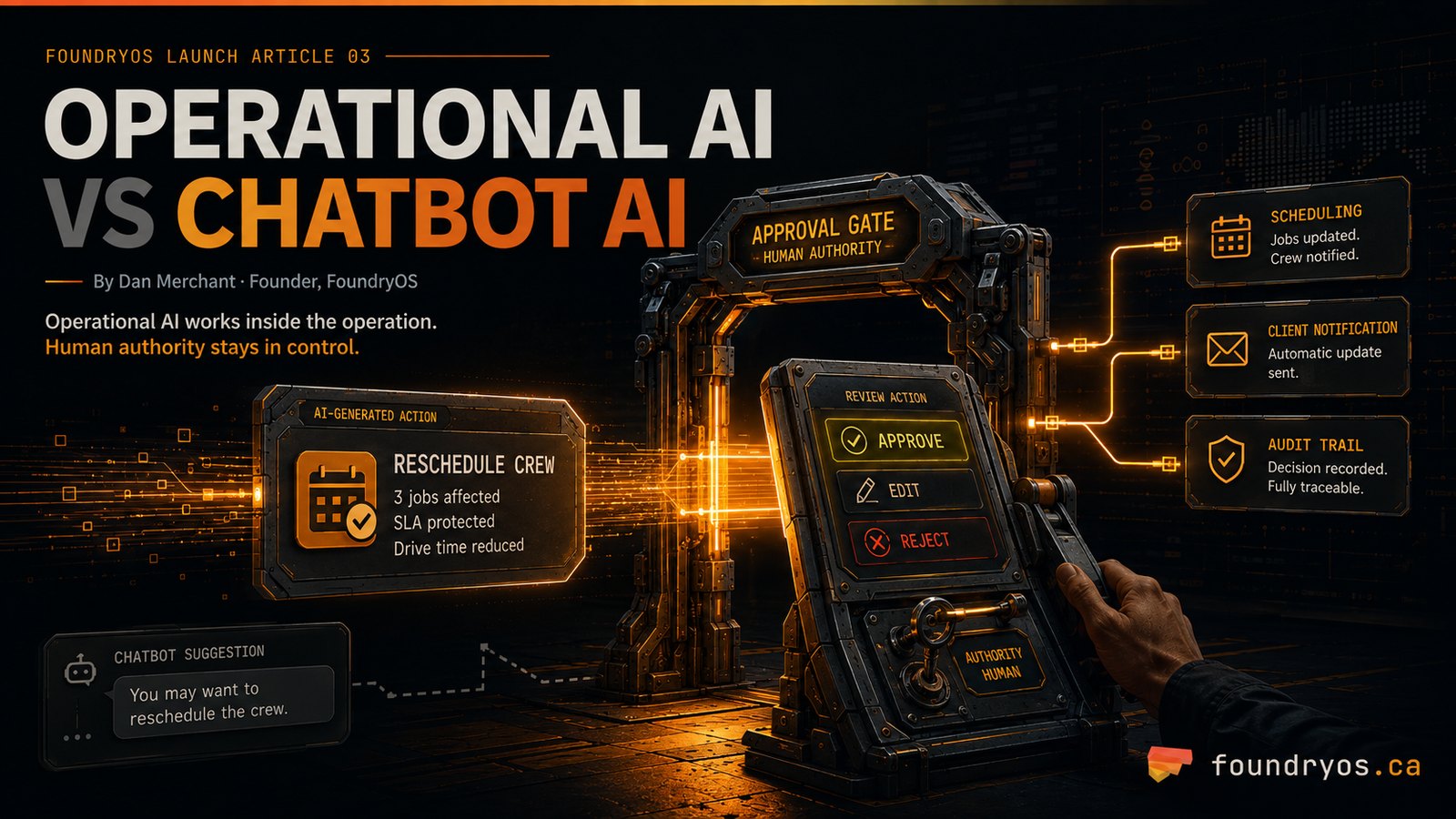
For most software, "AI" now means a chat box in the corner of the screen. You type a question, it types an answer, and everyone agrees the product has AI. It is the least interesting thing artificial intelligence can do for an operation — and it has quietly lowered the bar for what businesses expect from it.
A capable model can produce a working screen in minutes. A business does not operate on screens. It operates through permissions, handoffs, exceptions, records, infrastructure and consequences. FoundryOS is an operator-governed, automated software engineering department that turns business intent into the platform a business runs on, then keeps it connected to reality.
The technical companion. Component boundaries, the execution architecture, the evidence posture that reads every claim by the evidence supporting it, the failure-routing contract, and the CrewOS build trace, including a deliberate halt when source identity could not support a trustworthy verdict.
A language model cannot hold a forty-nine step procedure in its head and be relied on to come out the other side. So the procedure does not live in its head. It lives in a profile an engine walks, and the model is called for one bounded question at a time, with its answer checked against a closed contract before it can move anything. This note takes the engine apart, shows it driving a real application audit to a clean-certified close with zero human gate decisions, and ships it as something you can run.
The systems that carry a business to ten people are almost never the systems that carry it to forty. It is one of the most predictable transitions in business — and one of the most consistently underestimated. Growth rarely stalls because demand disappears. It stalls because the way you work was never designed to scale.
A coding agent ended a turn right after saying it was continuing, capable of the work, just treating turn-end as a fine place to stop. More instructions did not fix it. This note moves the rule to the runtime surface that can actually observe the failure: a Stop-hook gate that detects the contradiction and applies a pre-authored decision policy. One file, zero dependencies.
For two decades, software built around how your business actually works was a privilege. It went to organizations with enterprise budgets and year-long timelines. Everyone else was left with the same two options: bend your operations to fit off-the-shelf software, or stitch together a patchwork of tools and absorb the gaps in spreadsheets.